
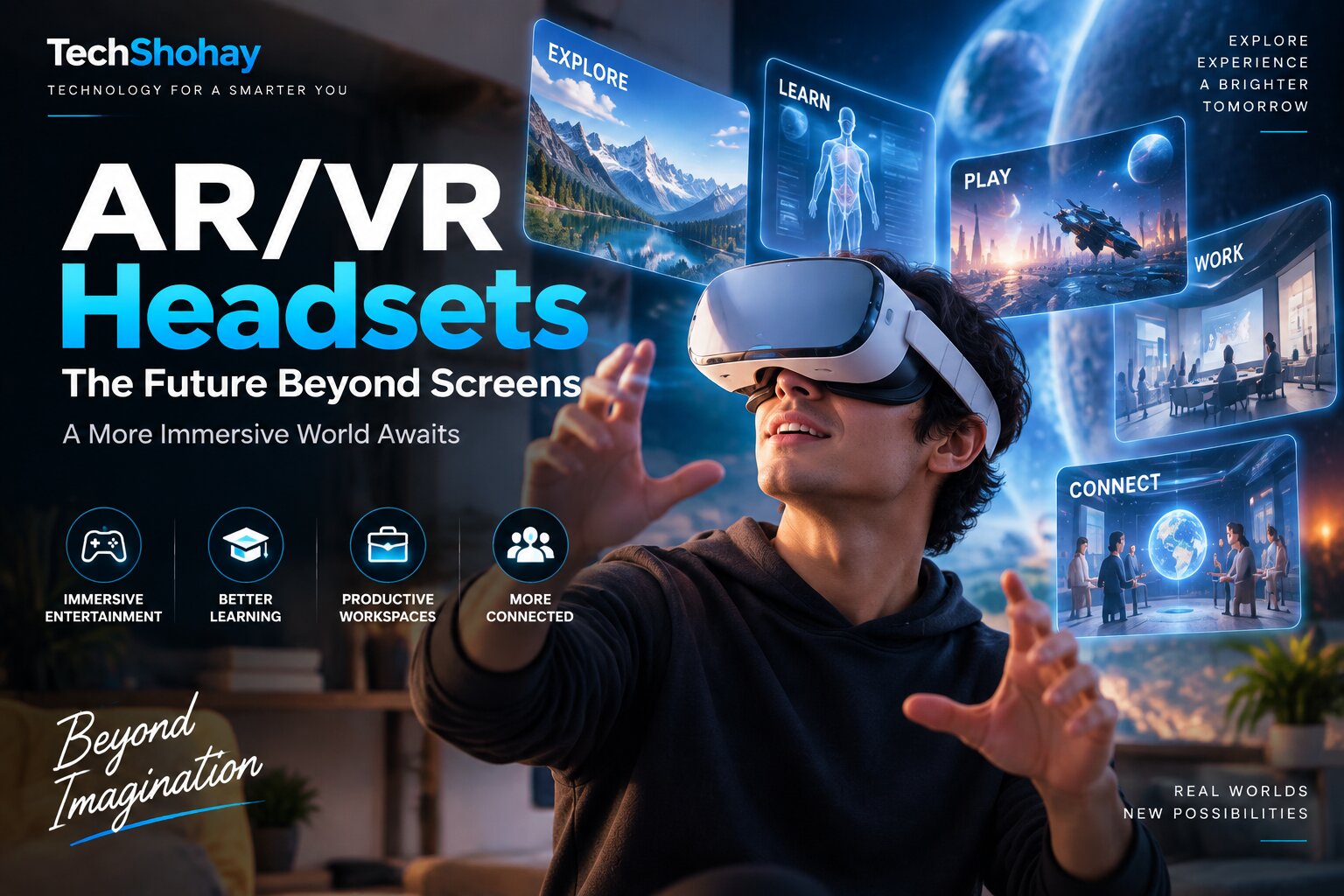
AR VR headsets are becoming one of the most interesting developments in the gadget industry as companies explore a future where digital experiences go beyond traditional screens.
For decades, people have interacted with technology through phones, computers and televisions. Augmented reality and virtual reality are changing that idea by placing digital experiences directly into the user's environment.
Although the technology is still developing, AR and VR headsets are opening new possibilities in entertainment, education, healthcare, gaming and professional work.
What Are AR and VR Headsets?
AR and VR headsets are wearable devices designed to create immersive digital experiences.
Virtual reality (VR) completely replaces the user's view of the real world with a digital environment.
Augmented reality (AR), on the other hand, adds digital information on top of the real world, allowing users to see virtual elements while remaining connected to their surroundings.
Some modern devices combine both technologies, often called mixed reality headsets.
Why AR VR Technology Is Getting Attention
The idea of immersive technology is not new, but recent improvements in processors, displays, cameras and artificial intelligence have made these devices more practical.
Modern headsets can track movement, understand surroundings and create more realistic digital experiences.
This has attracted interest from major technology companies that see immersive computing as a possible future platform.
How AR/VR Headsets Could Change Entertainment
Entertainment is one of the biggest areas where AR and VR technology is being explored.
Users can experience games, movies and virtual environments in a more interactive way compared with traditional screens.
Instead of watching content from a distance, immersive technology allows people to feel more connected with digital experiences.
Beyond Gaming: Real-World Uses
AR VR headsets are not only designed for entertainment.
Businesses are exploring these devices for employee training, design, engineering and remote collaboration.
For example, engineers can visualize complex designs in 3D, while companies can train employees using realistic virtual environments.
Education and Healthcare Applications
Immersive technology could also change how people learn and receive medical support.
Students may explore historical locations, scientific concepts and complex subjects through interactive experiences.
In healthcare, virtual reality is being studied for training, rehabilitation and certain therapeutic applications.
The Role of AI in AR and VR
Artificial intelligence is becoming an important part of immersive technology.
AI can help devices understand environments, recognize objects and provide more personalized experiences.
Future headsets may become smarter by combining AI assistants with spatial computing capabilities.
Challenges Facing AR VR Headsets
Despite the progress, several challenges remain.
Price is one of the biggest barriers. Advanced headsets require expensive displays, sensors and computing components.
Comfort is another challenge because users need lightweight devices that can be worn for longer periods.
Privacy is also important because these devices often use cameras and sensors to understand the user's surroundings.
Will AR VR Replace Smartphones?
It is unlikely that AR and VR headsets will immediately replace smartphones.
Instead, they may become another important way people interact with digital information.
Similar to how smartphones expanded beyond traditional phones, immersive devices may create a new category of computing.
The Future Beyond Screens
The biggest idea behind AR and VR is moving technology closer to the way humans naturally experience the world.
Instead of looking at information on a small display, users may interact with digital content around them.
This could create a future where computing becomes more immersive, interactive and personal.
Final Thoughts
AR VR headsets are still evolving, but they represent an important shift in the gadget industry.
The future of technology may not only depend on faster devices, but also on creating more natural ways for humans to interact with digital worlds.
As hardware improves and costs decrease, immersive technology could become a larger part of everyday life.